Is There a Martial Arts School in Chicago That Teaches Both Wing Chun and Aikido?
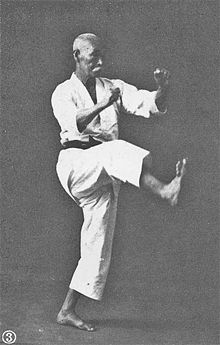 Chōmo Hanashiro, c. 1938 | |
| Also known as | Karate Do (空手道) |
|---|---|
| Focus | Striking |
| Hardness | Full-contact, semi-contact, low-cal-contact |
| Country of origin | Ryukyu Kingdom (Present twenty-four hour period Okinawa prefecture, Japan) |
| Parenthood | Indigenous martial arts of Ryukyu Islands, Chinese martial arts[1] [2] |
| Olympic sport | Debuted in 2021 |
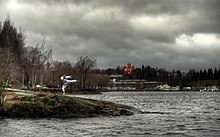
 Karate World Title 2006 in Tampere, Finland; men'south heavyweight final | |
| Highest governing trunk | Globe Karate Federation |
|---|---|
| Commencement developed | Ryukyu Kingdom, ca. 17th century |
| Characteristics | |
| Contact | Yep |
| Mixed-sex activity | No |
| Blazon | Martial art |
| Presence | |
| Land or region | Worldwide |
| Olympic | Debuted in 2021 |
| Globe Games | 1981 – 2017 |
| Karate | |||||
|---|---|---|---|---|---|
 "Karate" in kanji | |||||
| Japanese name | |||||
| Kanji | 空手 | ||||
| Hiragana | からて | ||||
| Katakana | カラテ | ||||
| |||||
Karate ( 空手 ) (; Japanese pronunciation: [kaɾate] (  heed ); Okinawan pronunciation: [kaɽati]) is a martial art developed in the Ryukyu Kingdom. It developed from the indigenous Ryukyuan martial arts (called te ( 手 ), "hand"; tii in Okinawan) under the influence of Chinese martial arts, particularly Fujian White Crane.[i] [2] Karate is at present predominantly a hit art using punching, kicking, articulatio genus strikes, elbow strikes and open-hand techniques such equally knife-hands, spear-easily and palm-heel strikes. Historically, and in some modern styles, grappling, throws, joint locks, restraints and vital-point strikes are besides taught.[three] A karate practitioner is called a karateka ( 空手家 ).
The Empire of Japan annexed the Ryukyu Kingdom in 1879. Karate came to mainland Japan in the early on 20th century during a fourth dimension of migration every bit Ryukyuans, particularly from Okinawa, looked for piece of work in the main islands of Nihon.[4] Information technology was systematically taught in Nippon after the Taishō era of 1912–1926.[5] In 1922, the Japanese Ministry of Education invited Gichin Funakoshi to Tokyo to give a karate demonstration. In 1924, Keio University established the first academy karate club in mainland Japan, and by 1932 major Japanese universities had karate clubs.[half dozen] In this era of escalating Japanese militarism,[7] the name was changed from 唐手 ("Chinese hand" or "Tang hand")[8] to 空手 ("empty manus") – both of which are pronounced karate in Japanese – to indicate that the Japanese wished to develop the gainsay class in Japanese way.[nine] Afterwards World State of war II, Okinawa became (1945) an important United States military site and karate became pop among servicemen stationed at that place.[10] [eleven]
The martial arts movies of the 1960s and 1970s served to greatly increase the popularity of martial arts around the world, and English language-speakers began to use the word karate in a generic way to refer to all hitting-based Asian martial arts.[12] Karate schools began appearing around the world, catering to those with casual interest as well as those seeking a deeper written report of the art.
Shigeru Egami, Chief Teacher of the Shotokan dōjō, opined that "the bulk of followers of karate in overseas countries pursue karate only for its fighting techniques ... Movies and television ... depict karate equally a mysterious way of fighting capable of causing death or injury with a unmarried blow ... the mass media present a pseudo art far from the existent matter."[xiii] Shōshin Nagamine said: "Karate may exist considered every bit the conflict within oneself or every bit a life-long marathon which can exist won only through self-discipline, hard preparation and one's ain creative efforts."[14]
On 28 September 2015 karate featured on a shortlist (forth with baseball, softball, skateboarding, surfing, and sport climbing) for consideration for inclusion in the 2020 Summer Olympics. On one June 2016 the International Olympic Committee's executive board announced they were supporting the inclusion of all five sports (counting baseball and softball every bit only one sport) for inclusion in the 2020 Games.
Web Japan (sponsored by the Japanese Ministry building of Foreign Affairs) claims that karate has 50 1000000 practitioners worldwide,[15] while the Globe Karate Federation claims in that location are 100 million practitioners around the world.[xvi]
Etymology [edit]
Karate was originally written as "Chinese hand" ( 唐手 , literally "Tang dynasty manus") in kanji. It was inverse to a homophone pregnant empty hand (空手) in 1935. The original employ of the give-and-take "karate" in print is attributed to Ankō Itosu; he wrote information technology equally "唐手". The Tang Dynasty of China ended in AD 907, simply the kanji representing it remains in use in Japanese language referring to China mostly, in such words as "唐人街" meaning Chinatown. Thus the word "karate" was originally a manner of expressing "martial fine art from Cathay."
Since there are no written records it is non known definitely whether the kara in karate was originally written with the grapheme 唐 meaning China or the character 空 significant empty. During the fourth dimension when admiration for Red china and things Chinese was at its summit in the Ryūkyūs it was the custom to use the former character when referring to things of fine quality. Influenced by this practice, in contempo times karate has begun to be written with the character 唐 to give it a sense of class or elegance.
—Gichin Funakoshi[17]
The first documented use of a homophone of the logogram pronounced kara by replacing the Chinese character meaning "Tang Dynasty" with the character pregnant "empty" took identify in Karate Kumite written in August 1905 by Chōmo Hanashiro (1869–1945). Sino-Japanese relations accept never been very good and especially at the fourth dimension of the Japanese invasion of Manchuria, referring to the Chinese origins of karate was considered politically wrong.[eighteen]
In 1933, the Okinawan fine art of karate was recognized equally a Japanese martial art by the Japanese Martial Arts Committee known as the "Butoku Kai". Until 1935, "karate" was written as "唐手" (Chinese hand). Simply in 1935, the masters of the various styles of Okinawan karate conferred to decide a new name for their art. They decided to call their art "karate" written in Japanese characters as "空手" (empty paw).[19]
Some other nominal development is the improver of dō (道:どう) to the end of the word karate. Dō is a suffix having numerous meanings including route, path, route and way. It is used in many martial arts that survived Nippon'southward transition from feudal culture to modern times. It implies that these arts are not simply fighting systems but contain spiritual elements when promoted as disciplines. In this context dō is ordinarily translated as "the manner of ___". Examples include aikido, judo, kyūdō and kendo. Thus karatedō is more than just empty mitt techniques. It is "The Way of the Empty Hand".
History [edit]
Okinawa [edit]

Karate began as a common fighting system known every bit te (Okinawan: ti) amongst the Pechin form of the Ryukyuans. Later trade relationships were established with the Ming dynasty of China in 1372 by King Satto of Chūzan, some forms of Chinese martial arts were introduced to the Ryukyu Islands by the visitors from Prc, particularly Fujian Province. A large group of Chinese families moved to Okinawa around 1392 for the purpose of cultural exchange, where they established the community of Kumemura and shared their knowledge of a wide variety of Chinese arts and sciences, including the Chinese martial arts. The political centralization of Okinawa by Rex Shō Hashi in 1429 and the policy of banning weapons by Male monarch Shō Shin in 1477, later enforced in Okinawa after the invasion past the Shimazu clan in 1609, are also factors that furthered the development of unarmed combat techniques in Okinawa.[two]
There were few formal styles of te, only rather many practitioners with their own methods. Ane surviving example is the Motobu-ryū schoolhouse passed downward from the Motobu family unit by Seikichi Uehara.[xx] Early styles of karate are ofttimes generalized as Shuri-te, Naha-te, and Tomari-te, named after the three cities from which they emerged.[19] Each area and its teachers had detail kata, techniques, and principles that distinguished their local version of te from the others.
Members of the Okinawan upper classes were sent to China regularly to study various political and practical disciplines. The incorporation of empty-handed Chinese Kung Fu into Okinawan martial arts occurred partly because of these exchanges and partly because of growing legal restrictions on the use of weaponry. Traditional karate kata bear a strong resemblance to the forms found in Fujian martial arts such as Fujian White Crane, Five Ancestors, and Gangrou-quan (Difficult Soft Fist; pronounced "Gōjūken" in Japanese).[21] Many Okinawan weapons such as the sai, tonfa, and nunchaku may have originated in and around Southeast Asia.[ citation needed ]
Sakukawa Kanga (1782–1838) had studied pugilism and staff (bo) fighting in People's republic of china (co-ordinate to ane legend, under the guidance of Kosokun, originator of kusanku kata). In 1806, he started instruction a fighting art in the urban center of Shuri that he called "Tudi Sakukawa," which meant "Sakukawa of China Manus." This was the first known recorded reference to the art of "Tudi," written as 唐手. Around the 1820s Sakukawa's most significant student Matsumura Sōkon (1809–1899) taught a synthesis of te (Shuri-te and Tomari-te) and Shaolin (Chinese 少林) styles.[ citation needed ] Matsumura'south style would after become the Shōrin-ryū style.
Matsumura taught his fine art to Itosu Ankō (1831–1915) among others. Itosu adapted two forms he had learned from Matsumura. These are kusanku and chiang nan.[22] He created the ping'an forms ("heian" or "pinan" in Japanese) which are simplified kata for starting time students. In 1901, Itosu helped to get karate introduced into Okinawa's public schools. These forms were taught to children at the unproblematic school level. Itosu's influence in karate is broad. The forms he created are common across about all styles of karate. His students became some of the most well-known karate masters, including Gichin Funakoshi, Kenwa Mabuni, and Chōki Motobu. Itosu is sometimes referred to equally "the Gramps of Modern Karate."[23]
In 1881, Higaonna Kanryō returned from China after years of instruction with Ryu Ryu Ko and founded what would get Naha-te. One of his students was the founder of Gojū-ryū, Chōjun Miyagi. Chōjun Miyagi taught such well-known karateka as Seko Higa (who likewise trained with Higaonna), Meitoku Yagi, Miyazato Ei'ichi, and Seikichi Toguchi, and for a very brief time near the end of his life, An'ichi Miyagi (a teacher claimed by Morio Higaonna).
In improver to the three early te styles of karate a fourth Okinawan influence is that of Uechi Kanbun (1877–1948). At the age of 20 he went to Fuzhou in Fujian Province, China, to escape Japanese military conscription. While there he studied under Shū Shiwa (Chinese: Zhou Zihe 周子和 1874-1926).[24] He was a leading figure of Chinese Nanpa Shorin-ken style at that time.[25] He later developed his own style of Uechi-ryū karate based on the Sanchin, Seisan, and Sanseiryu kata that he had studied in Cathay.[26]
Japan [edit]

Gichin Funakoshi, the founder of Shotokan karate, is generally credited with having introduced and popularized karate on the primary islands of Nippon. In addition, many Okinawans were actively educational activity, and are thus also responsible for the development of karate on the principal islands. Funakoshi was a pupil of both Asato Ankō and Itosu Ankō (who had worked to introduce karate to the Okinawa Prefectural Schoolhouse Arrangement in 1902). During this time menses, prominent teachers who also influenced the spread of karate in Nippon included Kenwa Mabuni, Chōjun Miyagi, Chōki Motobu, Kanken Tōyama, and Kanbun Uechi. This was a turbulent period in the history of the region. It includes Nihon'southward looting of the Okinawan island group in 1872, the Starting time Sino-Japanese State of war (1894–1895), the Russo-Japanese War (1904–1905), the annexation of Korea, and the rise of Japanese militarism (1905–1945).
Japan was invading China at the time, and Funakoshi knew that the art of Tang/China hand would not be accepted; thus the change of the art'due south name to "way of the empty hand." The dō suffix implies that karatedō is a path to self-noesis, not just a report of the technical aspects of fighting. Like near martial arts practised in Nippon, karate fabricated its transition from -jutsu to -dō around the starting time of the 20th century. The "dō" in "karate-dō" sets it apart from karate-jutsu, as aikido is distinguished from aikijutsu, judo from jujutsu, kendo from kenjutsu and iaido from iaijutsu.

Funakoshi changed the names of many kata and the name of the art itself (at least on mainland Nihon), doing then to become karate accepted by the Japanese budō organization Dai Nippon Butoku Kai. Funakoshi also gave Japanese names to many of the kata. The five pinan forms became known as heian, the three naihanchi forms became known as tekki, seisan as hangetsu, Chintō as gankaku, wanshu as enpi, and so on. These were by and large political changes, rather than changes to the content of the forms, although Funakoshi did introduce some such changes. Funakoshi had trained in two of the popular branches of Okinawan karate of the time, Shorin-ryū and Shōrei-ryū. In Nippon he was influenced by kendo, incorporating some ideas most distancing and timing into his manner. He e'er referred to what he taught every bit merely karate, but in 1936 he congenital a dōjō in Tokyo and the style he left behind is ordinarily called Shotokan later this dōjō. Shoto, meaning "pino wave", was Funakoshi's pen name and kan meaning "hall".
The modernization and systemization of karate in Japan as well included the adoption of the white uniform that consisted of the kimono and the dogi or keikogi—mostly chosen merely karategi—and coloured belt ranks. Both of these innovations were originated and popularized past Jigoro Kano, the founder of judo and i of the men Funakoshi consulted in his efforts to modernize karate.
A new form of karate called Kyokushin was formally founded in 1957 by Masutatsu Oyama (who was built-in a Korean, Choi Yeong-Eui 최영의). Kyokushin is largely a synthesis of Shotokan and Gōjū-ryū. It teaches a curriculum that emphasizes aliveness, physical toughness, and full contact sparring. Because of its emphasis on physical, full-strength sparring, Kyokushin is now often called "total contact karate", or "Knockdown karate" (later the proper noun for its competition rules). Many other karate organizations and styles are descended from the Kyokushin curriculum.
Exercise [edit]
Karate can be adept as an art (budō), self defence force or as a combat sport. Traditional karate places emphasis on self-evolution (budō).[27] Modern Japanese way preparation emphasizes the psychological elements incorporated into a proper kokoro (attitude) such as perseverance, fearlessness, virtue, and leadership skills. Sport karate places emphasis on do and competition. Weapons are an important training activeness in some styles of karate.
Karate grooming is commonly divided into kihon (nuts or fundamentals), kata (forms), and kumite (sparring).
Kihon [edit]
Kihon means basics and these form the base for everything else in the mode including stances, strikes, punches, kicks and blocks. Karate styles place varying importance on kihon. Typically this is preparation in unison of a technique or a combination of techniques by a group of karateka. Kihon may also be prearranged drills in smaller groups or in pairs.
Kata [edit]
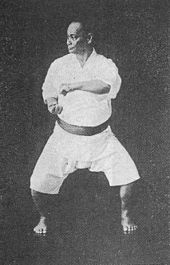
Chōki Motobu in Naihanchi-dachi, ane of the basic karate stances
Kata (型:かた) means literally "shape" or "model." Kata is a formalized sequence of movements which correspond various offensive and defensive postures. These postures are based on idealized combat applications. The applications when practical in a demonstration with existent opponents is referred to every bit a Bunkai. The Bunkai shows how every stance and motion is used. Bunkai is a useful tool to understand a kata.
To attain a formal rank the karateka must demonstrate competent performance of specific required kata for that level. The Japanese terminology for grades or ranks is commonly used. Requirements for examinations vary among schools.
Kumite [edit]
Sparring in Karate is called kumite (組手:くみて). Information technology literally means "meeting of easily." Kumite is good both as a sport and as self-defense training.
Levels of physical contact during sparring vary considerably. Full contact karate has several variants. Knockdown karate (such as Kyokushin) uses total power techniques to bring an opponent to the basis. In kickboxing variants (for example Chiliad-1), the preferred win is past knockout. Sparring in armour, bogu kumite, allows full power techniques with some condom. Sport kumite in many international competition under the World Karate Federation is gratis or structured with calorie-free contact or semi contact and points are awarded by a referee.
In structured kumite (yakusoku, prearranged), two participants perform a choreographed series of techniques with one striking while the other blocks. The form ends with one devastating technique (hito tsuki).
In free sparring (Jiyu Kumite), the 2 participants have a gratuitous choice of scoring techniques. The allowed techniques and contact level are primarily determined by sport or style organization policy, but might exist modified according to the age, rank and sex of the participants. Depending upon style, take-downs, sweeps and in some rare cases even time-express grappling on the ground are also immune.
Complimentary sparring is performed in a marked or closed expanse. The tour runs for a fixed time (2 to 3 minutes.) The time can run continuously (iri kume) or exist stopped for referee judgment. In light contact or semi contact kumite, points are awarded based on the criteria: good form, sporting attitude, vigorous application, awareness/zanshin, expert timing and correct distance. In full contact karate kumite, points are based on the results of the impact, rather than the formal appearance of the scoring technique.
Dōjō Kun [edit]
In the bushidō tradition dōjō kun is a set of guidelines for karateka to follow. These guidelines apply both in the dōjō (training hall) and in everyday life.
Conditioning [edit]
Okinawan karate uses supplementary training known equally hojo disengage. This utilizes simple equipment fabricated of wood and stone. The makiwara is a striking post. The nigiri game is a large jar used for developing grip strength. These supplementary exercises are designed to increment strength, stamina, speed, and musculus coordination.[28] Sport Karate emphasizes aerobic exercise, anaerobic practise, power, agility, flexibility, and stress management.[29] All practices vary depending upon the school and the teacher.
Sport [edit]
Gichin Funakoshi ( 船越 義珍 ) said, "There are no contests in karate."[30] In pre–World War II Okinawa, kumite was non role of karate training.[31] Shigeru Egami relates that, in 1940, some karateka were ousted from their dōjō because they adopted sparring subsequently having learned it in Tokyo.[32]
Karate is divided into style organizations.[33] These organizations sometimes cooperate in non-style specific sport karate organizations or federations. Examples of sport organizations include AAKF/ITKF, AOK, TKL, AKA, WKF, NWUKO, WUKF and WKC.[34] Organizations hold competitions (tournaments) from local to international level. Tournaments are designed to match members of opposing schools or styles against 1 another in kata, sparring and weapons sit-in. They are often separated by age, rank and sex with potentially different rules or standards based on these factors. The tournament may exist exclusively for members of a detail style (closed) or ane in which any martial artist from any manner may participate inside the rules of the tournament (open).
The World Karate Federation (WKF) is the largest sport karate organisation and is recognized by the International Olympic Committee (IOC) as being responsible for karate contest in the Olympic Games.[35] The WKF has developed common rules governing all styles. The national WKF organizations coordinate with their respective National Olympic Committees.
WKF karate competition has two disciplines: sparring (kumite) and forms (kata).[36] Competitors may enter either equally individuals or as part of a team. Evaluation for kata and kobudō is performed by a panel of judges, whereas sparring is judged by a head referee, ordinarily with assistant referees at the side of the sparring area. Sparring matches are typically divided by weight, age, gender, and experience.[37]
WKF but allows membership through one national organization/federation per country to which clubs may bring together. The World Marriage of Karate-practice Federations (WUKF)[38] offers dissimilar styles and federations a world body they may join, without having to compromise their style or size. The WUKF accepts more than 1 federation or association per country.
Sport organizations employ different contest rule systems.[33] [37] [39] [40] [41] Light contact rules are used by the WKF, WUKO, IASK and WKC. Full contact karate rules used by Kyokushinkai, Seidokaikan and other organizations. Bogu kumite (full contact with protective shielding of targets) rules are used in the World Koshiki Karate-Do Federation system.[42] Shinkaratedo Federation use boxing gloves.[43] Within the United states of america, rules may be under the jurisdiction of state sports government, such equally the battle commission.
In August 2016, the International Olympic Committee approved karate as an Olympic sport beginning at the 2020 Summertime Olympics.[44] [45]
Karate, although non widely used in mixed martial arts, has been effective for some MMA practitioners.[46] [47] Various styles of karate are practiced in MMA: Lyoto Machida and John Makdessi practice Shotokan;[48] Bas Rutten and Georges St-Pierre train in Kyokushin;[49] Michelle Waterson holds a black belt in American Costless Way Karate;[l] Stephen Thompson practices American Kenpo Karate;[51] and Robert Whittaker practices Gōjū-ryū.[52]
Rank [edit]
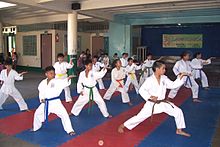
Karatekas wearing different colored belts
In 1924, Gichin Funakoshi, founder of Shotokan Karate, adopted the Dan system from the judo founder Jigoro Kano[53] using a rank scheme with a limited set of chugalug colors. Other Okinawan teachers also adopted this do. In the Kyū/Dan system the beginner grades start with a higher numbered kyū (e.g., tenth Kyū or Jukyū) and progress toward a lower numbered kyū. The Dan progression continues from 1st Dan (Shodan, or 'showtime dan') to the higher dan grades. Kyū-course karateka are referred to as "color belt" or mudansha ("ones without dan/rank"). Dan-grade karateka are referred to as yudansha (holders of dan/rank). Yudansha typically wear a black chugalug. Normally, the offset five to 6 dans are given past examination past superior dan holders, while the subsequent (vii and upwards) are honorary, given for special merits and/or age reached. Requirements of rank differ among styles, organizations, and schools. Kyū ranks stress opinion, balance, and coordination. Speed and power are added at higher grades.
Minimum age and fourth dimension in rank are factors affecting promotion. Testing consists of demonstration of techniques earlier a panel of examiners. This volition vary by schoolhouse, simply testing may include everything learned at that point, or just new information. The sit-in is an application for new rank (shinsa) and may include kata, bunkai, self-defense force, routines, tameshiwari (breaking), and kumite (sparring).
Philosophy [edit]
In Karate-Do Kyohan, Funakoshi quoted from the Heart Sutra, which is prominent in Shingon Buddhism: "Form is emptiness, emptiness is form itself" (shiki zokuze kū kū zokuze shiki).[54] He interpreted the "kara" of Karate-dō to mean "to purge oneself of selfish and evil thoughts ... for only with a clear mind and censor can the practitioner understand the knowledge which he receives." Funakoshi believed that one should be "inwardly humble and outwardly gentle." Simply by behaving humbly tin i exist open up to Karate's many lessons. This is washed by listening and beingness receptive to criticism. He considered courtesy of prime number importance. He said that "Karate is properly practical only in those rare situations in which one really must either down another or be downed past him." Funakoshi did not consider it unusual for a devotee to use Karate in a real physical confrontation no more than than perhaps in one case in a lifetime. He stated that Karate practitioners must "never be easily drawn into a fight." It is understood that one blow from a real expert could mean death. It is clear that those who misuse what they have learned bring dishonor upon themselves. He promoted the character trait of personal conviction. In "time of grave public crisis, one must take the backbone ... to face a million and one opponents." He taught that indecisiveness is a weakness.[55]
World [edit]
Africa [edit]
Karate has grown in popularity in Africa, particularly in South Africa and Ghana.[56] [57] [58]
Americas [edit]
Canada [edit]
Karate began in Canada in the 1930s and 1940s as Japanese people immigrated to the state. Karate was practised quietly without a large amount of system. During the Second World State of war, many Japanese-Canadian families were moved to the interior of British Columbia. Masaru Shintani, at the age of thirteen, began to study Shorin-Ryu karate in the Japanese military camp under Kitigawa. In 1956, after 9 years of training with Kitigawa, Shintani travelled to Japan and met Hironori Otsuka (Wado Ryu). In 1958, Otsuka invited Shintani to join his organization Wado Kai, and in 1969 he asked Shintani to officially telephone call his manner Wado.[59]
In Canada during this same time, karate was also introduced past Masami Tsuruoka who had studied in Japan in the 1940s under Tsuyoshi Chitose.[threescore] In 1954, Tsuruoka initiated the start karate competition in Canada and laid the foundation for the National Karate Association.[60]
In the late 1950s Shintani moved to Ontario and began teaching karate and judo at the Japanese Cultural Eye in Hamilton. In 1966, he began (with Otsuka's endorsement) the Shintani Wado Kai Karate Federation. During the 1970s Otsuka appointed Shintani the Supreme Instructor of Wado Kai in North America. In 1979, Otsuka publicly promoted Shintani to hachidan (8th dan) and privately gave him a kudan document (ninth dan), which was revealed by Shintani in 1995. Shintani and Otsuka visited each other in Japan and Canada several times, the terminal fourth dimension in 1980 ii years prior to Otsuka'southward death. Shintani died 7 May 2000.[59]
United States [edit]
Afterward World State of war Two, members of the U.s. military learned karate in Okinawa or Nippon so opened schools in the US. In 1945, Robert Trias opened the first dōjō in the Usa in Phoenix, Arizona, a Shuri-ryū karate dōjō.[61] In the 1950s, William J. Dometrich, Ed Parker, Cecil T. Patterson, Gordon Doversola, Donald Hugh Nagle, George Mattson and Peter Urban all began instructing in the U.s..
Tsutomu Ohshima began studying karate under Shotokan'southward founder, Gichin Funakoshi, while a student at Waseda University, beginning in 1948. In 1957, Ohshima received his godan (5th-degree black belt), the highest rank awarded past Funakoshi. He founded the commencement university karate club in the United States at California Establish of Technology in 1957. In 1959, he founded the Southern California Karate Clan (SCKA) which was renamed Shotokan Karate of America (SKA) in 1969.
In the 1960s, Anthony Mirakian, Richard Kim, Teruyuki Okazaki, John Pachivas, Allen Steen, Gosei Yamaguchi (son of Gōgen Yamaguchi), Michael G. Foster and Pat Burleson began teaching martial arts around the country.[62]
In 1961, Hidetaka Nishiyama, a co-founder of the Japan Karate Association (JKA) and pupil of Gichin Funakoshi, began teaching in the United States. He founded the International Traditional Karate Federation (ITKF). Takayuki Mikami was sent to New Orleans past the JKA in 1963.
In 1964, Takayuki Kubota relocated the International Karate Association from Tokyo to California.
Asia [edit]
Korea [edit]
Due to past conflict between Korea and Japan, most notably during the Japanese occupation of Korea in the early on 20th century, the influence of karate in Korea is a contentious upshot.[63] From 1910 until 1945, Korea was annexed by the Japanese Empire. It was during this time that many of the Korean martial arts masters of the 20th century were exposed to Japanese karate. Subsequently regaining independence from Japan, many Korean martial arts schools that opened up in the 1940s and 1950s were founded by masters who had trained in karate in Japan equally office of their martial arts preparation.
Won Kuk Lee, a Korean student of Funakoshi, founded the start martial arts school later the Japanese occupation of Korea ended in 1945, chosen the Chung Practice Kwan. Having studied under Gichin Funakoshi at Chuo University, Lee had incorporated taekkyon, kung fu, and karate in the martial art that he taught which he chosen "Tang Soo Practice", the Korean transliteration of the Chinese characters for "Mode of Chinese Hand" (唐手道).[64] In the mid-1950s, the martial arts schools were unified nether President Rhee Syngman's guild, and became taekwondo under the leadership of Choi Hong Hi and a committee of Korean masters. Choi, a pregnant figure in taekwondo history, had also studied karate under Funakoshi. Karate besides provided an important comparative model for the early founders of taekwondo in the formalization of their fine art including hyung and the belt ranking system. The original taekwondo hyung were identical to karate kata. Somewhen, original Korean forms were adult by individual schools and associations. Although the Globe Taekwondo Federation and International Taekwon-Do Federation are the almost prominent among Korean martial arts organizations, tang soo exercise schools that teach Japanese karate yet be as they were originally conveyed to Won Kuk Lee and his contemporaries from Funakoshi.
Soviet Matrimony [edit]
Karate appeared in the Soviet Matrimony in the mid-1960s, during Nikita Khrushchev's policy of improved international relations. The first Shotokan clubs were opened in Moscow's universities.[65] In 1973, however, the government banned karate—together with all other foreign martial arts—endorsing only the Soviet martial art of sambo.[66] [67] Failing to suppress these uncontrolled groups, the USSR'south Sport Commission formed the Karate Federation of USSR in December 1978.[68] On 17 May 1984, the Soviet Karate Federation was disbanded and all karate became illegal again. In 1989, karate practice became legal once more, only under strict government regulations, only after the dissolution of the Soviet Union in 1991 did independent karate schools resume performance, and and then federations were formed and national tournaments in accurate styles began.[69] [70]
Europe [edit]
In the 1950s and 1960s, several Japanese karate masters began to teach the fine art in Europe, simply it was not until 1965 that the Nippon Karate Association (JKA) sent to Europe four well-trained young Karate instructors Taiji Kase, Keinosuke Enoeda, Hirokazu Kanazawa and Hiroshi Shirai.[ citation needed ] Kase went to French republic, Enoeada to England and Shirai in Italy. These Masters maintained always a potent link betwixt them, the JKA and the others JKA masters in the world, specially Hidetaka Nishiyama in the US
France [edit]
France Shotokan Karate was created in 1964 by Tsutomu Ohshima. It is affiliated with another of his organizations, Shotokan Karate of America (SKA). However, in 1965 Taiji Kase came from Japan forth with Enoeda and Shirai, who went to England and Italy respectively, and karate came nether the influence of the JKA.
Italy [edit]
Hiroshi Shirai, one of the original instructors sent by the JKA to Europe along with Kase, Enoeda and Kanazawa, moved to Italy in 1965 and quickly established a Shotokan enclave that spawned several instructors who in their turn soon spread the style all over the country. By 1970 Shotokan karate was the near spread martial art in Italian republic apart from Judo. Other styles such every bit Wado Ryu, Goju Ryu and Shito Ryu, are nowadays and well established in Italy, while Shotokan remains the almost popular.
U.k. [edit]
Vernon Bell, a third Dan Judo instructor who had been instructed by Kenshiro Abbe introduced Karate to England in 1956, having attended classes in Henry Plée'southward Yoseikan dōjō in Paris. Yoseikan had been founded by Minoru Mochizuki, a master of multiple Japanese martial arts, who had studied Karate with Gichin Funakoshi, thus the Yoseikan style was heavily influenced by Shotokan.[71] Bell began educational activity in the tennis courts of his parents' back garden in Ilford, Essex and his group was to become the British Karate Federation. On 19 July 1957, Vietnamese Hoang Nam third Dan, billed every bit "Karate champion of Indo China", was invited to teach by Bell at Maybush Route, but the outset instructor from Japan was Tetsuji Murakami (1927–1987) a 3rd Dan Yoseikan under Minoru Mochizuki and 1st Dan of the JKA, who arrived in England in July 1959.[71] In 1959, Frederick Gille set up the Liverpool branch of the British Karate Federation, which was officially recognised in 1961. The Liverpool branch was based at Harold House Jewish Boys Order in Chatham Street before relocating to the YMCA in Everton where it became known equally the Ruddy Triangle. Ane of the early on members of this branch was Andy Sherry who had previously studied Jujutsu with Jack Britten. In 1961, Edward Ainsworth, another blackbelt Judoka, prepare up the first Karate study grouping in Ayrshire, Scotland having attended Bell'southward third 'Karate Summertime Schoolhouse' in 1961.[71]
Exterior of Bell's organisation, Charles Mack traveled to Japan and studied under Masatoshi Nakayama of the Japan Karate Clan who graded Mack to 1st Dan Shotokan on four March 1962 in Japan.[71] Shotokai Karate was introduced to England in 1963 past some other of Gichin Funakoshi's students, Mitsusuke Harada.[71] Outside of the Shotokan stable of karate styles, Wado Ryu Karate was also an early adopted way in the UK, introduced by Tatsuo Suzuki, a 6th Dan at the fourth dimension in 1964.
Despite the early adoption of Shotokan in the UK, it was not until 1964 that JKA Shotokan officially came to the Uk. Bell had been corresponding with the JKA in Tokyo asking for his grades to be ratified in Shotokan having apparently learnt that Murakami was not a designated representative of the JKA. The JKA obliged, and without enforcing a grading on Bell, ratified his black chugalug on five February 1964, though he had to relinquish his Yoseikan grade. Bell requested a visitation from JKA instructors and the next year Taiji Kase, Hirokazu Kanazawa, Keinosuke Enoeda and Hiroshi Shirai gave the first JKA demo at the old Kensington Town Hall on 21 April 1965. Hirokazu Kanazawa and Keinosuke Enoeda stayed and Murakami left (afterward re-emerging every bit a 5th Dan Shotokai under Harada).[71]
In 1966, members of the former British Karate Federation established the Karate Marriage of Great United kingdom of great britain and northern ireland (KUGB) under Hirokazu Kanazawa equally primary instructor[72] and affiliated to JKA. Keinosuke Enoeda came to England at the same time equally Kanazawa, teaching at a dōjō in Liverpool. Kanazawa left the Uk afterward 3 years and Enoeda took over. Afterward Enoeda'southward decease in 2003, the KUGB elected Andy Sherry every bit Main Instructor. Shortly after this, a new association split off from KUGB, JKA England. An before pregnant divide from the KUGB took place in 1991 when a group led by KUGB senior instructor Steve Cattle formed the English language Shotokan Academy (ESA). The aim of this group was to follow the teachings of Taiji Kase, formerly the JKA chief teacher in Europe, who forth with Hiroshi Shirai created the World Shotokan Karate-exercise University (WKSA), in 1989 in order to pursue the teaching of "Budo" karate equally opposed to what he viewed as "sport karate". Kase sought to return the exercise of Shotokan Karate to its martial roots, reintroducing amid other things open hand and throwing techniques that had been side lined every bit the upshot of competition rules introduced by the JKA. Both the ESA and the WKSA (renamed the Kase-Ha Shotokan-Ryu Karate-practice Academy (KSKA) after Kase's death in 2004) continue following this path today. In 1975, Great Britain became the first team e'er to take the World male team title from Nihon subsequently being defeated the previous twelvemonth in the final.
In film and popular civilisation [edit]
Karate spread apace in the West through popular culture. In 1950s popular fiction, karate was at times described to readers in near-mythical terms, and information technology was credible to show Western experts of unarmed combat as unaware of Eastern martial arts of this kind.[73] Following the inclusion of judo at the 1964 Tokyo Olympics, there was growing mainstream Western involvement in Japanese martial arts, particularly karate, during the 1960s.[74] By the 1970s, martial arts films (especially kung fu films and Bruce Lee flicks from Hong Kong) had formed a mainstream genre and launched the "kung fu craze" which propelled karate and other Asian martial arts into mass popularity. However, mainstream Western audiences at the time more often than not did not distinguish between different Asian martial arts such as karate, kung fu and tae kwon practise.[51]
The Karate Child (1984) and its sequels The Karate Kid, Part Two (1986), The Karate Child, Part III (1989) and The Next Karate Kid (1994) are films relating the fictional story of an American adolescent'south introduction into karate.[75] [76] Its television sequel, Cobra Kai (2018), has led to similar growing interest in karate.[77] The success of The Karate Kid further popularized karate (as opposed to Asian martial arts more generally) in mainstream American popular civilisation.[51] Karate Kommandos is an animated children's prove, with Chuck Norris actualization to reveal the moral lessons contained in every episode.
Many other film stars such as Bruce Lee, Chuck Norris, Jackie Chan, Sammo Hung, and Jet Li come from a range of other martial arts.
See also [edit]
- Comparison of karate styles
- Japanese martial arts
- Karate World Championships
- Karate at the Summertime Olympics
- Karate at the Globe Games
References [edit]
- ^ a b Higaonna, Morio (1985). Traditional Karatedo Vol. 1 Fundamental Techniques. p. 17. ISBN0-87040-595-0.
- ^ a b c "History of Okinawan Karate". two March 2009. Archived from the original on ii March 2009. Retrieved 14 March 2013.
- ^ Bishop, Mark (1989). Okinawan Karate. pp. 153–166. ISBN0-7136-5666-2. Chapter ix covers Motobu-ryu and Bugeikan, two 'ti' styles with grappling and vital point hitting techniques. Page 165, Seitoku Higa: "Apply force per unit area on vital points, wrist locks, grappling, strikes and kicks in a gentle manner to neutralize an attack."
- ^ Kerr, George. Okinawa: History of an Island People. Tokyo: Tuttle Publishing Visitor, 2000. 436, 442, 448-449.
- ^ Donn F. Draeger (1974). Modernistic Bujutsu & Budo. Weatherhill, New York & Tokyo. Page 125.
- ^ "唐手研究会、次いで空手の創立". Keio Univ. Karate Team. Archived from the original on 12 July 2009. Retrieved 12 June 2009.
- ^ Miyagi, Chojun (1993) [1934]. McCarthy, Patrick (ed.). Karate-doh Gaisetsu [An Outline of Karate-Do]. p. 9. ISBN4-900613-05-3.
- ^ The name of the Tang dynasty was a synonym for "China" in Okinawa.
- ^ Draeger & Smith (1969). Comprehensive Asian Fighting Arts. p. 60. ISBN978-0-87011-436-6.
- ^ "Here's how Usa Marines brought karate back home afterward World War 2". We Are The Mighty. 2 April 2018. Retrieved 11 March 2021.
- ^ Bishop, Mark (1999). Okinawan Karate 2d Edition. p. 11. ISBN978-0-8048-3205-2.
- ^ Gary J. Krug (1 November 2001). "Dr. Gary J. Krug: the Feet of the Master: Iii Stages in the Appropriation of Okinawan Karate Into Anglo-American Culture". Csc.sagepub.com. Archived from the original on 17 Feb 2008. Retrieved 14 March 2013.
- ^ Shigeru, Egami (1976). The Heart of Karate-Practise. p. thirteen. ISBN0-87011-816-1.
- ^ Nagamine, Shoshin (1976). Okinawan Karate-do. p. 47. ISBN978-0-8048-2110-0.
- ^ "Spider web Japan" (PDF) . Retrieved 14 March 2013.
- ^ "WKF claims 100 million practitioners". Thekisontheway.com. Archived from the original on 26 April 2013. Retrieved 14 March 2013.
- ^ Funakoshi, Gishin (1988). Karate-do Nyumon. Japan. p. 24. ISBNfour-7700-1891-half dozen . Retrieved fifteen July 2010.
- ^ "What's In A Name?". Newpaltzkarate.com. Archived from the original on 10 December 2004. Retrieved five March 2015.
- ^ a b Higaonna, Morio (1985). Traditional Karatedo Vol. 1 Fundamental Techniques. p. 19. ISBN0-87040-595-0.
- ^ Bishop, Marking (1989). Okinawan Karate. p. 154. ISBN0-7136-5666-ii. Motobu-ryū & Seikichi Uehara
- ^ Bishop, Mark (1989). Okinawan Karate. p. 28. ISBN0-7136-5666-2. For example Chōjun Miyagi adjusted Rokkushu of White Crane into Tenshō
- ^ Lund, Graeme. The Essential Karate Book: For White Belts, Black Belts and All Karateka in Between. p. 12.
- ^ International Ryukyu Karate-jutsu Research Society (15 October 2012). "Patrick McCarthy, footnote #4". Archived from the original on 30 January 2014. Retrieved 23 May 2014.
- ^ Fujimoto, Keisuke (2017). The Untold Story of Kanbun Uechi. pp. 19.
- ^ "Kanbun Uechi history". 1 March 2009. Archived from the original on 1 March 2009. Retrieved 23 May 2014.
- ^ Hokama, Tetsuhiro (2005). 100 Masters of Okinawan Karate. Okinawa: Ozata Print. p. 28.
- ^ "International Traditional Karate Federation (ITKF)". Archived from the original on 4 December 2010. Retrieved 23 May 2014.
- ^ Higaonna, Morio (1985). Traditional Karatedo Vol. i Primal Techniques. p. 67. ISBN0-87040-595-0.
- ^ Mitchell, David (1991). Winning Karate Competition. p. 25. ISBN0-7136-3402-2.
- ^ Shigeru, Egami (1976). The Centre of Karatedo. p. 111. ISBN0-87011-816-i.
- ^ Higaonna, Morio (1990). Traditional Karatedo Vol. four Applications of the Kata. p. 136. ISBN978-0870408489.
- ^ Shigeru, Egami (1976). The Heart of Karatedo. p. 113. ISBN0-87011-816-1.
- ^ a b Goldstein, Gary (May 1982). "Tom Lapuppet, Views of a Champion". Black Belt Mag. Active Interest Media. p. 62. Retrieved 13 October 2015.
- ^ "Globe Karate Confederation". Wkc-org.net. Retrieved 14 March 2013.
- ^ "Action Report" (PDF) . Retrieved fourteen March 2013.
- ^ "The Global Allure of Karate". 2 January 2017. Retrieved xx March 2018.
- ^ a b Warnock, Eleanor (25 September 2015). "Which Kind of Karate Has Olympic Chops?". WSJ. Retrieved eighteen October 2015.
- ^ "WUKF – World Matrimony of Karate-Do Federations". Wukf-karate.org. Retrieved 14 March 2013.
- ^ "Black Belt". September 1992. p. 31. Retrieved 10 October 2015.
- ^ Joel Alswang (2003). The South African Dictionary of Sport. p. 163. ISBN9780864865359 . Retrieved x October 2015.
- ^ Adam Gibson; Bill Wallace (2004). Competitive Karate. ISBN9780736044929 . Retrieved x October 2015.
- ^ "Globe Koshiki Karatedo Federation". Koshiki.org. Retrieved 14 March 2013.
- ^ "Shinkaratedo Renmei". Shinkarate.net. Retrieved xiv March 2013.
- ^ "IOC approves five new sports for Olympic Games Tokyo 2020". IOC. Retrieved 4 August 2016.
- ^ "Olympics: Baseball/softball, sport climbing, surfing, karate, skateboarding at Tokyo 2020". BBC . Retrieved 4 August 2016.
- ^ "Technique Talk: Stephen Thompson Retrofits Karate for MMA". MMA Fighting. Retrieved 23 May 2014.
- ^ "Lyoto Machida and the Revenge of Karate". Sherdog . Retrieved 13 Feb 2010.
- ^ Lead MMA Analyst (fourteen Feb 2014). "Lyoto Machida: One-time-School Karate". Bleacher Report . Retrieved 23 May 2014.
- ^ Wickert, Marc. "Montreal's MMA Warrior". Knucklepit.com. Archived from the original on 13 June 2007. Retrieved 6 July 2007.
- ^ "Who is Michelle Waterson?". mmamicks.com. 8 June 2015.
- ^ a b c Schneiderman, R. M. (23 May 2009). "Contender Shores Upwards Karate's Reputation Amongst U.F.C. Fans". The New York Times. Archived from the original on 7 May 2013. Retrieved 30 January 2010.
- ^ {{cite spider web|url=https://world wide web.sherdog.com/news/articles/5-Things-You-Might-Non-Know-About-Robert-Whittaker-149391 |title=five Things Y'all Might Not Know About Robert Whitakker |publisher=sherdog.com |date=viii February 2019
- ^ Hokama, Tetsuhiro (2005). 100 Masters of Okinawan Karate. Okinawa: Ozata Print. p. 20.
- ^ Funakoshi, Gichin. "Karate-dō Kyohan – The Principal Text" Tokyo. Kodansha International; 1973. Page 4
- ^ Funakoshi, Gichin. "Karate-dō Kyohan – The Master Text" Tokyo. Kodansha International; 1973.
- ^ "National Sports Authorization, Ghana". Sportsauthority.com.gh. Archived from the original on 2 April 2015. Retrieved 5 March 2015.
- ^ Resnekov, Liam (16 July 2014). "Love and Rebellion: How Ii Karatekas Fought Apartheid | FIGHTLAND". Fightland.vice.com. Retrieved 5 March 2015.
- ^ Aggrey, Joe (6 May 1997). "Graphic Sports: Event 624 May 6-12 1997". Graphic Communications Group. Retrieved 22 August 2017 – via Google Books.
- ^ a b Robert, T. (2006). "no title given". Journal of Asian Martial Arts. this issue is not bachelor equally a back outcome. 15 (4). [ expressionless link ]
- ^ a b "Karate". The Canadian Encyclopedia – Historica-Dominion. 2010. Retrieved 20 July 2010.
- ^ Harty, Sensei Thomas. "About Grandmaster Robert Trias". suncoastkarate.com . Retrieved xiii February 2018.
- ^ The Original Martial Arts Encyclopedia, John Corcoran and Emil Farkas, pgs. 170–197
- ^ Orr, Monty; Amae, Yoshihisa (December 2016). "Karate in Taiwan and Republic of korea: A Tale of Two Postcolonial Societies" (PDF). Taiwan in Comparative Perspective. Taiwan Inquiry Program, London Schoolhouse of Economics. half dozen: 1–16. ISSN 1752-7732. Archived from the original (PDF) on xi Baronial 2017. Retrieved 24 July 2017.
- ^ "Academy". Tangsudo.com. 18 October 2011. Archived from the original on ten December 2014. Retrieved five March 2015.
- ^ Inc, Active Interest Media (1 June 1979). "Black Belt". Agile Interest Media, Inc. Retrieved 3 January 2018 – via Google Books.
- ^ Risch, William Jay (17 December 2014). Youth and Rock in the Soviet Bloc: Youth Cultures, Music, and the State in Russia and Eastern Europe. Lexington Books. ISBN9780739178232 . Retrieved 3 January 2018 – via Google Books.
- ^ Hoberman, John G. (xxx June 2014). Sport and Political Ideology. Academy of Texas Printing. ISBN9780292768871 . Retrieved three Jan 2018 – via Google Books.
- ^ Inc, Active Involvement Media (ane July 1979). "Blackness Belt". Active Interest Media, Inc. Retrieved iii January 2018 – via Google Books.
- ^ Volkov, Vadim (4 February 2016). Violent Entrepreneurs: The Use of Force in the Making of Russian Capitalism. Cornell University Printing. ISBN9781501703287 . Retrieved 3 January 2018 – via Google Books.
- ^ Tomlinson, Alan; Young, Christopher; Holt, Richard (17 June 2013). Sport and the Transformation of Mod Europe: States, Media and Markets 1950-2010. Routledge. ISBN9781136660528 . Retrieved 3 January 2018 – via Google Books.
- ^ a b c d due east f "Exclusive: UK Karate History". Bushinkai. Archived from the original on 23 February 2014.
- ^ "International Association of Shotokan Karate (IASK)". Karate-iask.com. Archived from the original on 29 May 2013. Retrieved fourteen March 2013.
- ^ For example, Ian Fleming's book Goldfinger (1959, p.91–95) describes the protagonist James Bond, an expert in unarmed combat, as utterly ignorant of Karate and its demonstrations, and describes the Korean 'Oddjob' in these terms: Goldfinger said, "Accept you ever heard of Karate? No? Well that man is 1 of the three in the earth who have achieved the Black Chugalug in Karate. Karate is a co-operative of judo, only it is to judo what a spandau is to a catapult...". Such a description in a popular novel assumed and relied upon Karate being almost unknown in the Westward.
- ^ Polly, Matthew (2019). Bruce Lee: A Life. Simon and Schuster. p. 145. ISBN978-one-5011-8763-6.
- ^ "The Karate Generation". Newsweek. 18 February 2010.
- ^ "Jaden Smith Shines in The Karate Kid". Newsweek. x June 2010.
- ^ "Local dojo experiencing business concern boon after 'Cobra Kai'". KRIS. 11 Jan 2021. Retrieved 9 April 2021.
- ^ "International Karate Organization KYOKUSHINKAIKAN Domestic Black Belt Listing Every bit of Oct.2000". Kyokushin Karate Sōkan : Shin Seishin Shugi Eno Sōseiki E. Aikēōshuppanjigyōkyoku: 62–64. 2001. ISBN4-8164-1250-6.
- ^ Rogers, Ron. "Hanshi's Corner 1106" (PDF). Midori Yama Budokai. Archived from the original (PDF) on eighteen Jan 2012. Retrieved 20 Baronial 2011.
- ^ HIROYUKI SANADA: "PROMISES" FOR PEACE THROUGH Picture. Ezine.kungfumagazine.com. Kung Fu Mag, Retrieved on 21 November 2011. Archived 12 November 2013 at the Wayback Machine
- ^ "Celebrity Fitness—Dolph Lundgren". Inside Kung Fu. Archived from the original on 29 November 2010. Retrieved 15 November 2010.
- ^ "Talking With…Michael Jai White". GiantLife . Retrieved 16 June 2010.
- ^ "Yasuaki Kurata Filmography". Retrieved 17 May 2017.
- ^ [one] Archived 28 September 2009 at the Wayback Machine
- ^ "Martial Arts Legend". north.d. Retrieved 29 July 2013.
- ^ Blackness Belt Mag March, 1994, p. 24. March 1994. Retrieved 14 March 2013.
- ^ "Goju-ryu". northward.d. Retrieved 24 June 2013.
- ^ "Yukari Oshima's Biography". Archived from the original on 28 August 2012. Retrieved 24 June 2013.
- ^ "Goju-ryu". north.d. Archived from the original on 3 September 2015. Retrieved 26 May 2014.
- ^ "Wesley Snipes: Action man courts a new beginning". Independent. London. 4 June 2010. Retrieved ten June 2010.
- ^ "Why is he famous?". Ask MEN. Archived from the original on 9 April 2010. Retrieved 15 June 2010.
- ^ "Martial arts biography - jim kelly". Archived from the original on 29 Baronial 2013. Retrieved 21 August 2013.
- ^ "Biography and Contour of Joe Lewis". Retrieved 12 August 2013.
- ^ [2] Archived five March 2013 at the Wayback Machine
- ^ "Matt Mullins Biography". n.d. Archived from the original on 8 May 2013. Retrieved 29 July 2013.
- ^ "'Ninja' Knockin Em Expressionless - Chicago Tribune" . Articles.chicagotribune.com. fifteen May 1986. Retrieved 5 March 2015.
- ^ Leavold, Andrew (2017). "Goons, guts and exploding huts!". The Search for Weng Weng. Australia: The LedaTape Arrangement. p. 80. ISBN9780994411235.
External links [edit]
- World Karate Federation
whitesidethonflused.blogspot.com
Source: https://en.wikipedia.org/wiki/Karate

Post a Comment for "Is There a Martial Arts School in Chicago That Teaches Both Wing Chun and Aikido?"